
Europe
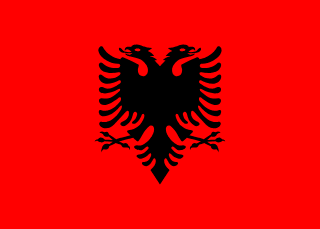
Albania sits on the Balkan Peninsula in southeastern Europe, bordered by Montenegro to the northwest, Kosovo to the northeast, North Macedonia to the east, and Greece to the south, with a coastline on the Adriatic and Ionian Seas.
Albania's name comes from an ancient tribal name recorded by Roman-era writers, though Albanians themselves call their country Shqipëria, generally translated as 'land of the eagles.'
Landscape: Mostly mountainous and hilly, with a coastal plain along the Adriatic and Ionian Seas.
Climate: Mediterranean along the coast, colder and more continental in the mountainous interior.
Food: Tavë kosi, baked lamb with rice and a yoghurt-based sauce, is widely considered the national dish.
Tirana became Albania's capital in 1920, chosen partly for its central location, replacing the earlier capital of Durrës. With a population of around 900,000 across the metropolitan area, it has transformed significantly since the fall of communism in the early 1990s, with brightly painted buildings replacing the city's formerly uniform grey Soviet-era architecture.
The double-headed eagle, appearing on Albania's flag, ties to the national hero Skanderbeg, who resisted Ottoman rule in the 15th century using the same symbol, itself drawn from earlier Byzantine imperial tradition.
Traditional Albanian qeleshe, a white felt cap, and elaborately embroidered folk costume remain worn at festivals, and Albania has a long tradition of silver filigree jewellery-making, particularly in the town of Kruja. Traditional Albanian polyphonic singing, particularly from the south of the country, is recognised by UNESCO as a distinctive and increasingly rare vocal tradition.
Berat, known as the 'city of a thousand windows' for its densely stacked Ottoman-era houses, is a UNESCO World Heritage Site, and Butrint, an ancient city with layers spanning Greek, Roman, and Byzantine occupation, is another significant historic site.
Albania's mountainous interior supports brown bears, wolves, and lynx, and its Adriatic and Ionian coastlines have increasingly drawn attention for relatively undeveloped beaches compared to some neighbouring countries. The Albanian Alps, sometimes called the 'Accursed Mountains,' remain one of Europe's least developed mountain ranges, preserving significant wilderness habitat.
Albania is religiously mixed, with Muslim, Orthodox Christian, and Catholic communities all present, and the country is notable for having enforced state atheism particularly strictly under communist rule, after which religious practice re-emerged relatively modestly compared to some neighbours.
Albania is a significant exporter of textiles, footwear, and minerals, including chromium, of which it's one of the larger global producers.
Independence Day on November 28th marks 1912, when Albania declared sovereignty from the Ottoman Empire, and Liberation Day, observed the day after on November 29th, marks the end of occupation during the Second World War, together forming a significant late-November period of national reflection. Summer Day on March 14th, an ancient pre-Christian celebration welcoming spring, remains widely observed with particular enthusiasm in the city of Elbasan. Teacher's Day in March remains a genuinely significant occasion, with students customarily honouring their teachers nationwide.
Football holds the largest domestic following in Albania by a wide margin, and the country's qualification for Euro 2016, its first ever major tournament appearance, was treated as a landmark national sporting achievement. Weightlifting has also produced notable Albanian competitors at the international level. Albanian basketball has also grown in domestic popularity, with several players competing in European leagues.
Albania is a parliamentary republic, with a President elected by parliament serving a largely ceremonial role and a Prime Minister holding real executive power, accountable to a single-chamber Assembly. The country emerged from one of the most isolated and rigidly enforced communist regimes in the world following the collapse of Enver Hoxha's government in the early 1990s, and has since pursued membership in both NATO and the European Union. Albania's NATO membership since 2009 marked a significant shift from its Cold War-era isolation.
Korab, on the border with North Macedonia, is Albania's highest point at 2,764 metres. The lowest point sits at sea level along Albania's Adriatic and Ionian coastlines.
Montenegro's flag shares Albania's use of a double-headed eagle emblem, tracing back to shared Byzantine heraldic tradition across the wider Balkan region, though set on differently coloured fields, red for Albania, red bordered in gold for Montenegro, different enough that the two aren't especially likely to be confused despite the shared eagle motif.
The double-headed eagle dates back to the 15th-century national hero Skanderbeg, with the modern flag formally adopted in 1912 upon independence from the Ottoman Empire.
One of the most mountainous countries in Europe, with roughly 70% of its land covered by mountains and hills.
Play today's Flagpie →© Flagpie 2026